
Podstawy teorii kwantów
Kwantyzacja układów klasycznych, teoria pomiaru kwantowego i dynamika układów otwartych.
FIZYKA TEORETYCZNA
Politechnika Wrocławska Wrocław

01 / OBSZARY BADAŃ
Kwantyzacja układów klasycznych, teoria pomiaru kwantowego i dynamika układów otwartych.

Fermionowy opis dynamiki układów kwantowych w przestrzeni fazowej.

Efektywny opis szumu kwantowego i opis mechaniki kwantowej w ujęciu stochastycznym.
02 / PUBLIKACJE
2020 / PHYSICAL REVIEW A
Physical Review A 102, 033338 (2020)
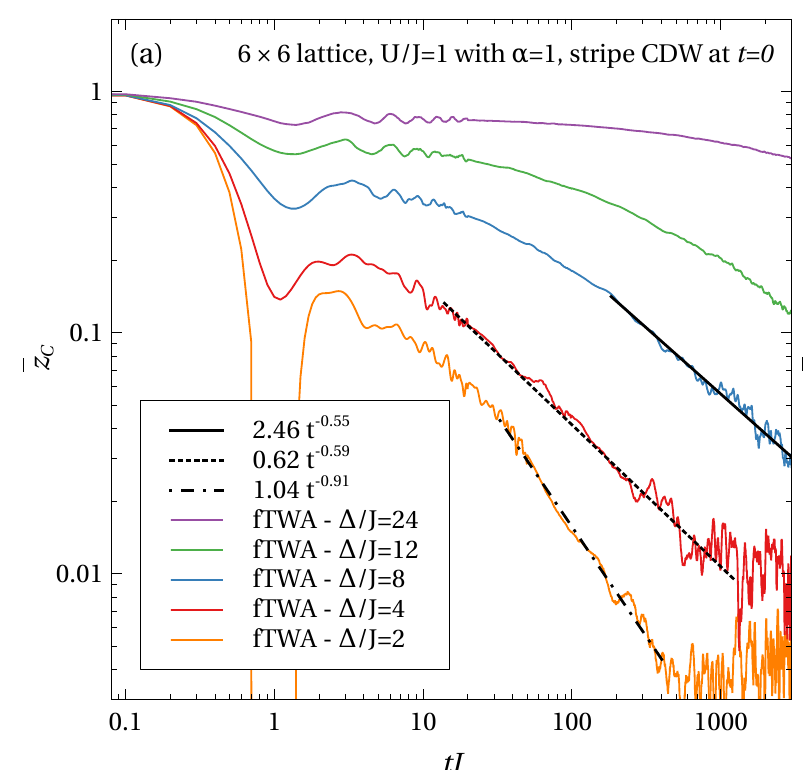
A fermionic semiclassical approach tracks the dynamics of disordered, interacting two-dimensional systems. Charge and spin relax on distinct timescales: at weaker disorder, charge can spread subdiffusively while spin remains diffusive. Strong disorder also produces slow, logarithmic growth of quantum Fisher information.
2025 / PHYSICAL REVIEW B
Physical Review B 111, 094207 (2025)
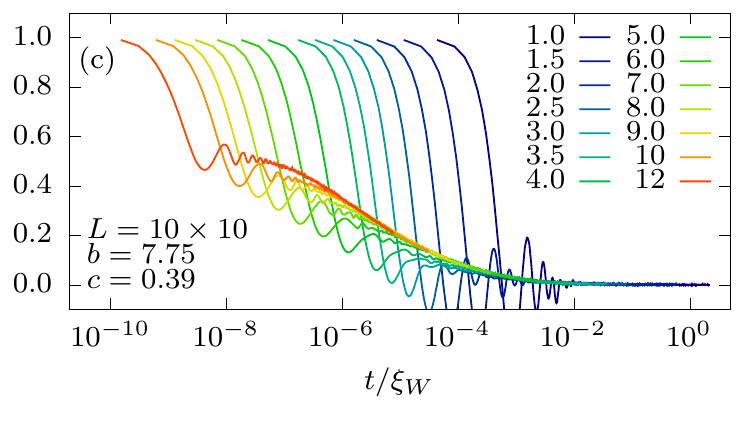
A single-trajectory fermionic semiclassical method enables simulations of large disordered two-dimensional lattices. Their imbalance follows a universal curve when time is rescaled by a disorder-dependent timescale, revealing exceptionally slow relaxation in two dimensions.
2022 / PHYSICAL REVIEW A
Physical Review A 105, 012206 (2022)
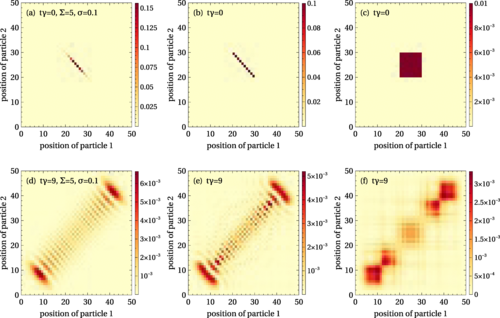
Entanglement alone does not determine whether particles move collectively. Globally entangled noninteracting systems can show collective motion, yet smaller subsystems need only classical correlations to do so. Some collective effects under external potentials require direct interactions between particles.
2019 / PHYSICAL REVIEW A
Physical Review A 100, 052111 (2019)
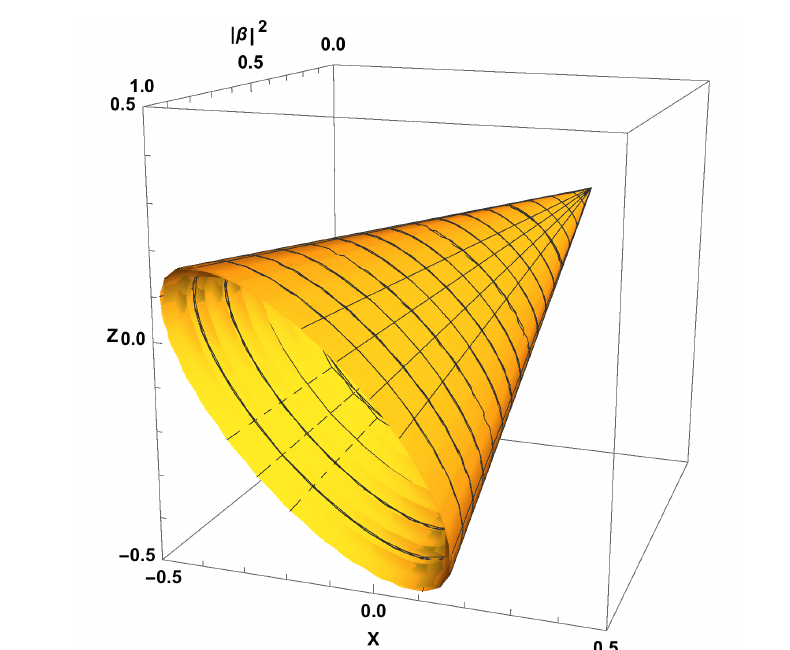
A quantum walk on a cycle with a random phase shift at one site can approach a fully or partially mixed state, or settle into an oscillating attractor. The asymptotic orbit may preserve entanglement between the walker's position and coin, even when the initial state is separable.
2023 / PHYSICAL REVIEW B
Physical Review B 108, 134304 (2023)
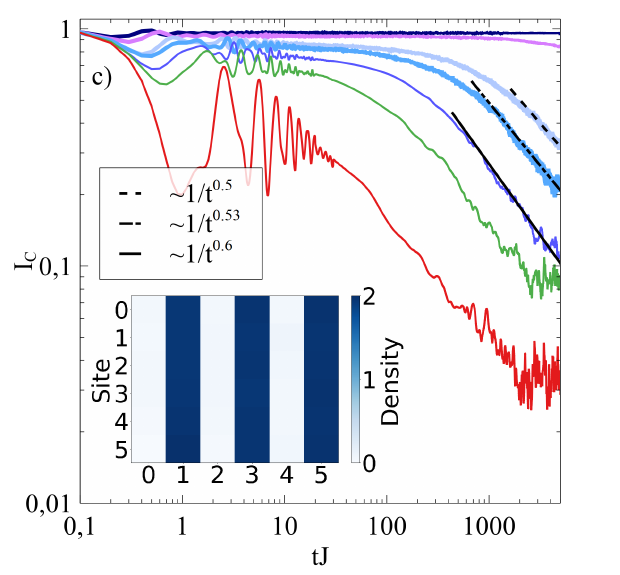
Fermionic semiclassical simulations explore charge and spin dynamics in a Hubbard model with tilted and harmonic potentials. In two dimensions, the combined potentials can produce subdiffusive relaxation and separate regions with distinct dynamical behavior despite the absence of disorder.
2018 / PHYSICAL REVIEW A
Physical Review A 98, 062105 (2018)
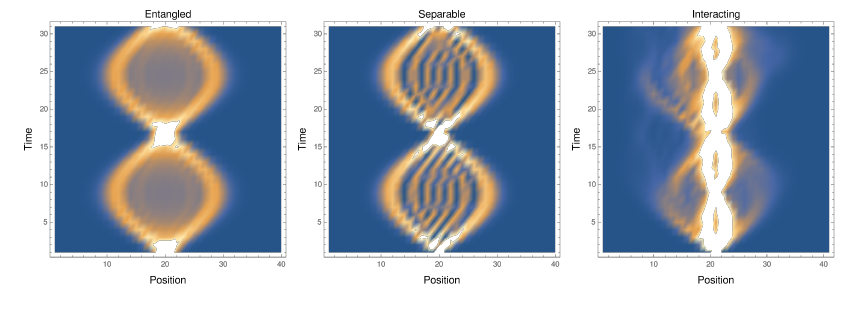
Entanglement can make two noninteracting particles behave like one object in some settings. More complex collective behavior generally requires an interaction or a postselected measurement; entanglement alone cannot make each particle's local dynamics depend on the other.